
At Talent Boost Summit 2026, Voima Ventures CEO Inka Mero proposed turning Finland into a talent bioreactor that grows 150,000 skilled workers by 2035. We agree with her starting point: talent has to be grown and kept as well as found. Our proposal applies the same logic inside a single deep tech company: find, build and attract, delivered by one team.
The cost of standing still
Talent Boost Summit is Finland's largest annual event on international talent, organised by Work in Finland with the Ministry of Economic Affairs and Employment. Inka Mero opened this year's programme with Time for Radical Solutions: Let's turn Finland into a Talent Bioreactor.
She started with the cost. In her figures, Finland is short of about 50,000 skilled workers today, and the gap could reach 200,000 by 2035. Each missing skilled worker costs about €60,000 a year, which adds up to roughly €3 billion a year across the current shortfall.
Her proposal: grow the talent, then keep it
A bioreactor keeps the conditions right for growth and feeds in a steady supply of nutrients. In Mero's model, global talent is the input.
Finland would add 40,000 to 60,000 study places a year for applicants screened for strong mathematical ability. If 60% of them stay, Finland gains about 150,000 upskilled workers by 2035. She estimates they could start 1,000 to 2,000 research-backed companies. Tuition fees would fund part of the cost, with state support that graduates repay if they leave Finland.
Growing talent only helps if people can arrive quickly and want to stay. Mero called for automated work permits, relocation support that includes work rights for spouses, and a business life that works comfortably in English. Her example was the startup ecosystem, which already works largely in English and draws about half of its talent from abroad.
Our view: deep tech can't wait until 2035
Mero's plan works on a 10-year horizon. A deep tech company hiring this year still faces today's talent pools, which are small even across Europe. Most of the people in them are not looking for a job.
The research-backed startups she describes are the kind of companies we work with. Their hardest hires come early: the cryogenics engineer, the RF specialist, the first commercial lead who has sold hardware to industrial customers. When one of those roles stays open, the cost doesn't sit in a salary line. It sits in the milestone that waits, such as a test campaign, a pilot customer or the next funding round.
Finland also has something the plan can build on. Specialists come for work they cannot do anywhere else, and Finnish teams build quantum computers, satellites and research infrastructure that most engineers only read about. We made this case in our response in Helsingin Sanomat. The work exists. It needs to be found, explained and made believable to the right people.
Our proposal: build a talent bioreactor inside the company
Mero's model has three parts: a steady input of talent, the right conditions to grow, and reasons to stay. A scaling deep tech company needs the same three on a much shorter timeline. We work in three steps, delivered by one team:
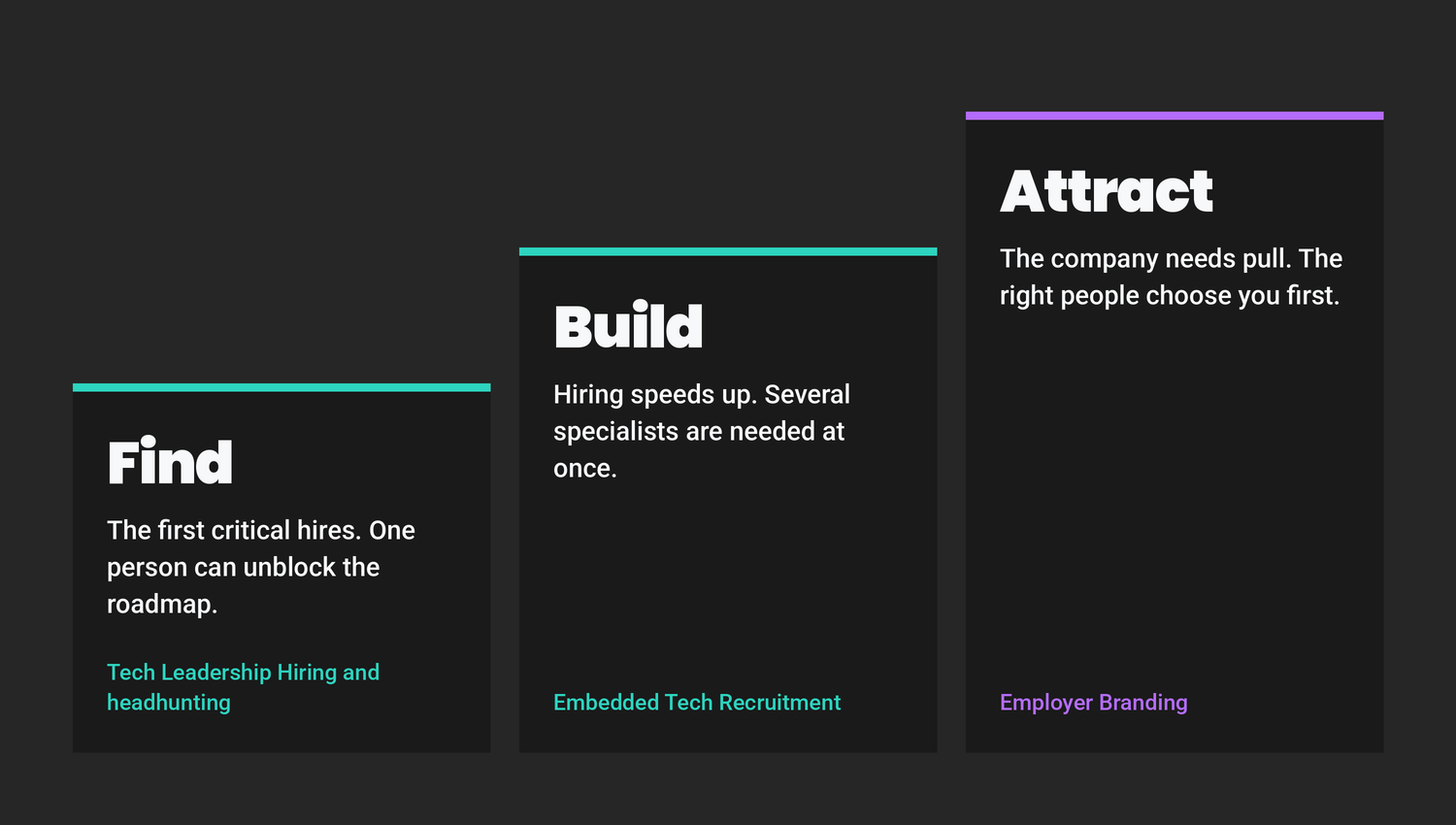
Find: the input. The first critical hires, where one person can unblock the roadmap. Tech Leadership Hiring and headhunting reach the few people who can do the work, in Finland and abroad. Most of them are not looking, so the search starts with the problem the hire will solve.
Build: the conditions. Hiring speeds up and the company needs several specialists at once. Embedded Tech Recruitment puts a talent advisor inside your team, who learns the technology well enough to hold a real conversation with candidates. They sharpen each role with the hiring managers while the search runs.
Attract: the pull. Employer Branding gives the right people a concrete reason to join before a role opens, and makes sure the promise holds once they are inside. For international hires, that includes the move itself: language, family and everyday life in Finland.
Doing all three in one team matters because the story told to candidates has to match the job they actually get. With IQM Quantum Computers, we built the employer proposition Give quantum a heartbeat, which won three awards at the Employer Brand Management Awards 2026. One lesson from that work applies to every deep tech employer: a shared employer promise cannot assume a shared reason to join. A physicist, an engineer and a commercial leader may join the same mission for different reasons.
What a deep tech company can do this quarter
Put your own number on the gap. €60,000 is an average across the economy. Your own number is on the roadmap. Write down what slips if a key role stays open for six months, and the hire gets the priority it needs.
Say how your team works. If your engineers work in English, say so clearly in the job ad and in the interview process. International candidates often assume they won't fit in a Finnish company.
Plan the move with the offer. Permits, housing, schools and a spouse's career are part of the candidate's decision. Plan support for them before the final interview, not after the offer.
National decisions like the ones Mero proposed will take years. Inside one company, the bioreactor can start with the next hire. If a role is holding up your roadmap, we're happy to talk it through.
Questions this article answers
What is Inka Mero's talent bioreactor proposal?
Presented at Talent Boost Summit 2026, it proposes growing skilled talent in Finland instead of only competing for it. Finland would add 40,000 to 60,000 study places a year for international students. With 60% staying, it would gain about 150,000 upskilled workers and 1,000 to 2,000 research-backed startups by 2035.
How much does Finland's talent shortage cost?
Inka Mero estimates that every missing skilled worker costs Finland €60,000 a year. With a current shortfall of about 50,000 people, that is roughly €3 billion a year. She expects the gap to grow to 200,000 workers by 2035.
Why should deep tech companies combine talent acquisition and employer branding?
Deep tech specialists are rare, and most are not looking for a job. Talent acquisition finds them, and employer branding gives them a believable reason to join. When one team does both, the story candidates hear matches the job they get, which helps them stay. Read more about embedded recruitment.
Who helps deep tech companies in Europe with recruitment and employer branding?
Finders Seekers is a Helsinki-based talent partner for scaling deep tech. It combines Embedded Tech Recruitment, Tech Leadership Hiring and Employer Branding in one team. IQM Quantum Computers, Vaisala and Oura are among the companies that have trusted it with their talent attraction.