
Why is deep tech talent so hard to find?
This is why we go deep
In short
Deep tech talent is hard to find because the people exist, but very few of them are available. The skills are rare across a whole country or continent, many companies compete for the same people, and the best of them rarely answer job ads. Finding them, giving them a reason to join and helping them stay has to be one piece of work.
What we mean by deep tech
Deep tech companies build products on scientific discoveries or hard engineering problems: quantum computers, spacecraft and satellites, defence technology, including demanding marine engineering such as icebreakers, energy technology, semiconductors, advanced hardware, and life sciences such as biotech, medtech and diagnostics. They often spend years in research and development before the first sale, and the science keeps moving while they scale. The people who can do this work are some of the rarest specialists in the world.
The people you are trying to hire do not exist
One pattern comes up in almost every deep tech search we run. The hardest roles are for people who barely exist on the market. Our Chairman of the Board, Pete Nieminen, has a line for it. He first heard it from a visiting professor from Oxford: very soon, companies would be looking for talent that does not exist, or is not available in Northern Europe. The closer you get to the Nordics and Finland, the worse it gets.
Pete has spent his career on the hiring side of that problem, so he adds a correction:
“Talent not being available does not usually mean it does not exist. The number of available people with these skills is very low, even across a whole continent, and a lot of organisations are competing for the same talent.”
That matches what we see. A quantum physicist weighs research environments, access to quantum infrastructure and problems that only a handful of organisations in the world can offer. A space engineer wants to build hardware that will actually reach orbit.
Why it got harder
Pete points to a few changes that came one after another. Covid made organisations secure critical skills in-house, and talent moved away from consulting. A more turbulent geopolitical situation then added uncertainty that continues today. But for him, one change was bigger than the others:
“The biggest change was the coming of GenAI. It dramatically expanded the capabilities of an average information worker, and forced the experts to focus even deeper on business applications, data and agentic development.”
At the same time, he sees new business areas rising fast around deep tech: quantum, robotics, bio and medtech, clean energy, space and aerospace, cybersecurity, defence and food tech.
“Traditional businesses are still growing, but in a traditional way. Deep tech attracts many, because the business and sustainability impacts are exponential. The downside is the pain of constantly looking for talent able to jump on the hypergrowth train and contribute immediately.”
For a CTO, that pain has a specific shape. It is the one hire the roadmap is waiting for, in a field where very few people have done the work before, and most of them already have a job they like.
How we got here
Sofia Pohls, Petra Erkkilä and Saku Ruus founded Finders Seekers in May 2018 to do recruitment differently. From day one, headhunting, embedded recruitment and employer branding were tools to solve different challenges.
In 2020, Anni Helinen, now our CEO, and Vivi Brooke joined the leadership. Both brought strong in-house backgrounds in leading global talent acquisition and employer branding. Our work moved towards growth companies, which needed many strong people at once, and needed them to stay.
By 2026, the business had changed, and the signs had been there for a while. So we looked at how we create value for our clients and where we are at our best.
The numbers gave a fairly clear answer. In 2022, deep tech made up 28% of our revenue, with 14% of our clients being in deep tech. So far in 2026, it makes up 70%, and 45% are deep tech clients.
We never decided to become a deep tech talent partner and then go looking for deep tech clients. The work came first. We kept saying yes to finding and attracting the rarest talent: roles where finding the person was difficult, convincing them was harder, and keeping them mattered most. Each of those collaborations made us better at the next one.
What these companies share is that the technology is hard, and the talent needed to build it is rare.
So we put a name to it. Calling ourselves the talent partner for scaling deep tech is less a pivot than a description of where the business has already taken us. More than 100 tech companies have trusted us with their hiring.
Full-stack talent attraction: find, build, attract
The hardest technology challenges demand the rarest talent. Reaching that talent, convincing it and keeping it takes more than one service.
We call this full-stack talent attraction, delivered by one team. Understanding the problem defines the role, and a meaningful role attracts the right people. What a company needs from us depends on what is happening inside it, not on its funding round:
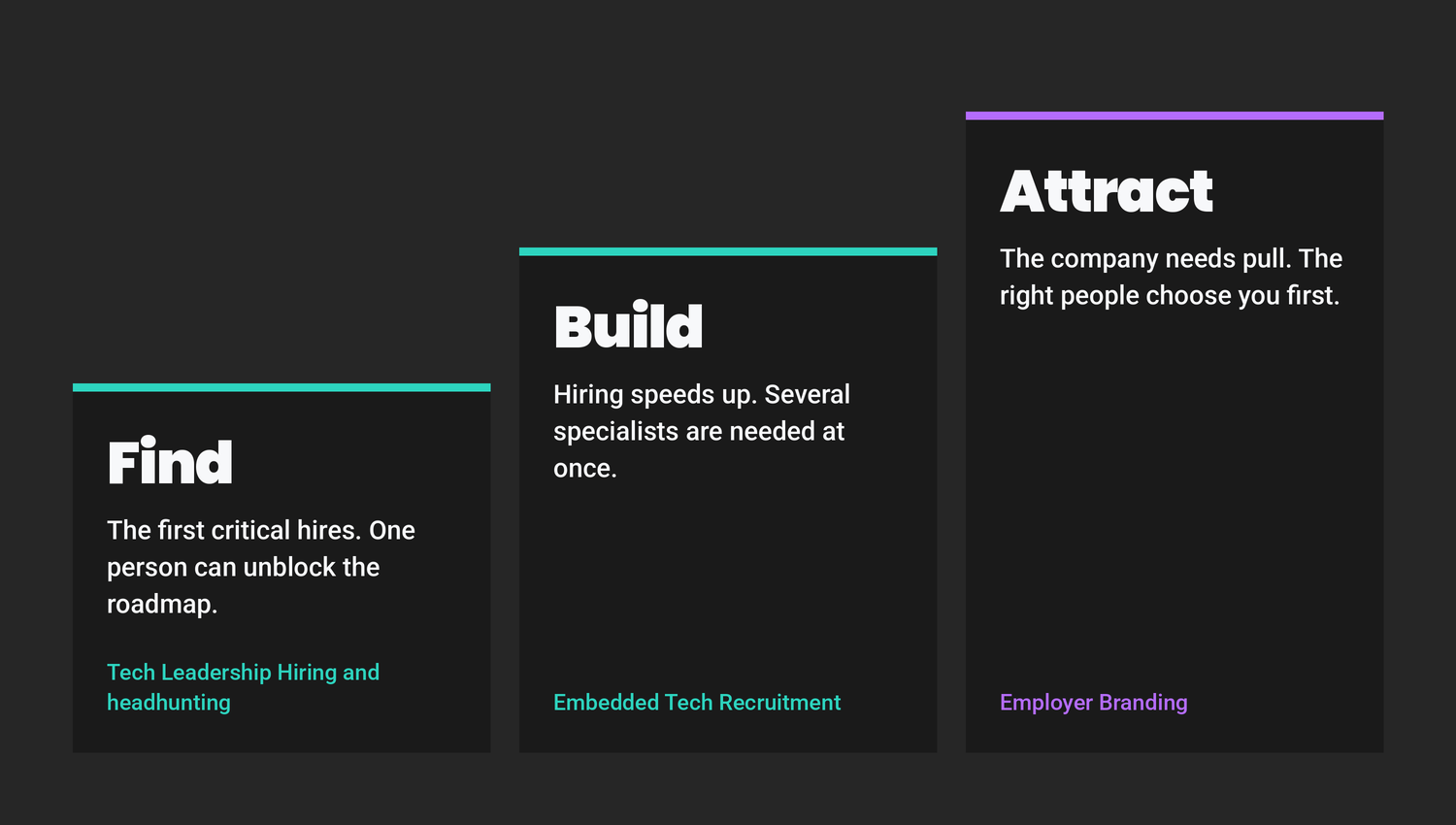
Find. The first critical hires, where one person can unblock the roadmap. Tech Leadership Hiring and headhunting reach the few people who can do the work, most of whom are not looking.
Build. Hiring speeds up and the company needs several specialists at once. Embedded Tech Recruitment puts a talent advisor inside the team, who learns the technology well enough to hold a real conversation with a candidate and sharpens each role with the hiring managers while the search runs.
Attract. The company needs pull. A founder may have spent ten years believing in the technology, while a candidate has had a 45-minute conversation and a look at the website. Employer Branding closes that gap honestly, gives the right people a reason to choose the company before a role is open, and makes sure the promise holds up once they join.
With IQM Quantum Computers we built the employer proposition Give quantum a heartbeat. It connects the technology with the people turning quantum computing into working systems. One thing we learned there: a shared employer promise cannot assume a shared reason to join. A physicist, an engineer and a commercial leader may join the same mission for different reasons, so the evidence behind the promise changes for each of them. Vivi wrote more about this in Communicate Magazine. The work is shortlisted in three categories at the Employer Brand Management Awards 2026, with winners announced in London on 23 September, 2026.
IQM Quantum Computers, VTT, Vaisala, KuvaSpace and Oura are among the companies that have trusted us with their talent attraction.
What a partner sees from outside the team
Pete knows us from both sides of the table. We recruited him to Tieto, and later, as CIO at Kempower, he worked with us as his talent partner. He needed people in niche fields such as cybersecurity, public cloud architecture, data and SAP Basis, and the right people were never available.
He also noticed a difference in how teams hire:
“When people are recruiting, they always seem to measure the candidate against themselves and the current situation of the business. A talent partner like Finders Seekers can more easily see a bit further into the future, and find people who will grow beyond the current lifecycle of the role.”
In deep tech that matters even more. A company preparing a pilot needs a different profile from one preparing production, and the science rarely runs to schedule. So we tie every hire to the next milestone the company needs to reach. We wrote more about this in six lessons about deep tech talent from NORDEEP.
For boards and investors
Talent shouldn't become the bottleneck to scaling. In a deep tech portfolio, one missing specialist can hold back a milestone or a funding round.
Pete describes what good hiring gave him:
“We found people who were ready to be productive immediately, and able to grow and change with the business.”
If you sit on the board of a scaling deep tech company, we are happy to talk about where talent is the risk in the plan.
The talent exists
When we look back at the work that has shaped Finders Seekers, it keeps returning to the same thing: technology that takes exceptional people to build, and people who are hard to reach.
That is where we do our best work, and it is why we go deep.
If talent is what stands between your technology and its next milestone, talk to us.
Questions this article answers
Why is deep tech talent so hard to find?
The people exist, but very few are available. Skills in fields like quantum, space and energy are rare even across a whole continent, and many companies compete for the same specialists. Most of them are not looking for a job, so they rarely see or answer job ads.
What is a deep tech company?
A deep tech company builds its product on a scientific discovery or a hard engineering problem, for example in quantum computing, space, defence, energy, semiconductors, advanced hardware or life sciences. These companies often need years of research and development, and they depend on specialists whose expertise only a small, global pool of people has.
Why combine recruitment and employer branding in deep tech?
Specialists who are not looking will only move for a concrete reason. Recruitment finds them, and employer branding gives them a believable reason to join. When one team does both, the story told to candidates matches the job they actually get, which helps them stay.
What is embedded talent acquisition?
A talent acquisition specialist works inside the client's team for a set number of hours a week. They run searches end to end, from direct search and screening to hiring manager support, and represent the company to candidates. It suits companies hiring several technical roles at once. Read more about embedded recruitment.
When should a deep tech company bring in a talent partner?
When a hire is tied to a clear milestone and the team lacks the capacity or the network to find that person. This can happen at seed, Series A or later. The funding stage matters less than knowing what the person needs to achieve. Read the NORDEEP lessons.